applied
Etsy, Mercado Libre and Rakuten: IP expectations for new sellers
Three marketplaces where network consistency matters in different ways. What to check before you register.
Only what we have verified ourselves: how to tell a real residential IP from a datacenter, how platforms treat hosting ranges, and a checklist to run before opening a store.
Three marketplaces where network consistency matters in different ways. What to check before you register.
When something is off, changing everything at once destroys the evidence. This is the order that keeps the diagnosis intact.
A VPN hides your city, not your category. Here is what the platform can infer from a VPN exit versus a residential line.
One profile per store is the usual advice. Here is what leaks between profiles even when you follow it.
Per-GB, per-IP, per-port — the pricing models are not comparable. Here is how to convert them into a cost per usable address.
Flagging is rarely permanent. What actually changes an address reputation, how long it takes, and when replacing it is the only option.
Our report page is meant to be forwarded. Here is what each number means and which parts actually settle an argument.
Before any fingerprinting, a platform can compare your IP timezone with your browser timezone and language. Here is how to align them.
A VPN can hide your IP while your DNS queries still go to a local resolver. Here is what that reveals and how to check it.
Reviews are usually caused by a small cluster of inconsistencies. Here is the catalogue sellers report most often, ordered by how much you can control.
Rotation is a feature for scraping and a bug for store accounts. A short decision guide with the trade-offs.
Mobile proxies cost more and rotate more. Here is when they help a store — and when they are just an expensive version of the same risk.
Most warm-up failures are not dramatic — they are small inconsistencies repeated for a week. Here are the seven we see most.
A practical comparison of what each marketplace looks at, and which parts an IP check can cover.
The IP is one of several linking signals — and usually not the strongest. Here is what links accounts and what does not.
Panic changes make it worse. A short, ordered checklist for handling a flagged IP or an account review.
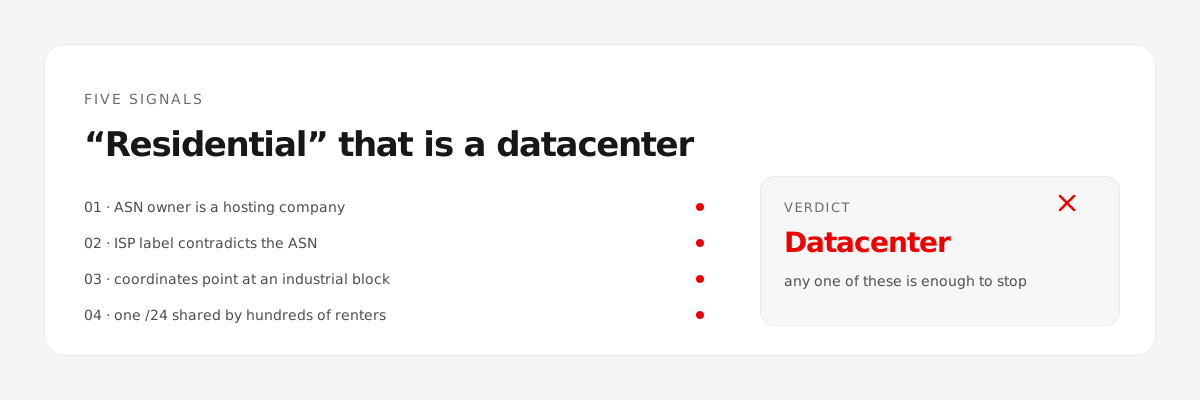
Most “residential” pools are resold hosting ranges. These eight questions — and a 20-address test — separate the two.
Shopee checks local phone, payment country and network together. Here is how to line them up before you register.
Cloud provider ranges, Spamhaus DROP, PeeringDB and the Tor exit list: what each one gives you, where it fails, and how to combine them without buying a commercial database.
TCP/IP stack fingerprints, open proxy ports and their limits — and why an HTTP-side check cannot replace them.
A practical walkthrough: authentication, batching, concurrency, retries and quota accounting with real code.
Where geolocation data comes from, what accuracy_radius really means, why free and commercial databases disagree, and how often they update.
IPv6 changes what "an IP" means: users control most of the address, clients rotate it, and a /64 is a single household. Here is what that does to attribution.
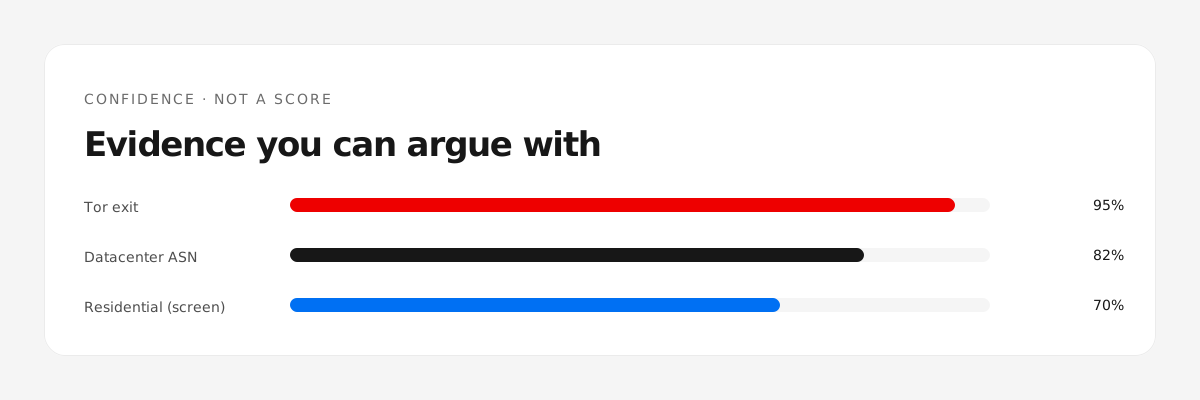
A technical walkthrough of how an IP becomes a verdict: which signals are used, how confidence is assigned, and the limits we accept.
The list is public and updated constantly. Here is where it comes from, how often it changes, and the mistakes to avoid when matching.
One IP, many locations. How anycast works, what it does to geolocation, and why a CDN edge is a poor identity for a store.
RDAP is the structured replacement for WHOIS. Here is how to query prefix ownership and which fields actually help an IP check.
PTR records are set by the network owner. Here is how to read them, the patterns that suggest a home line, and the cases where they lie.
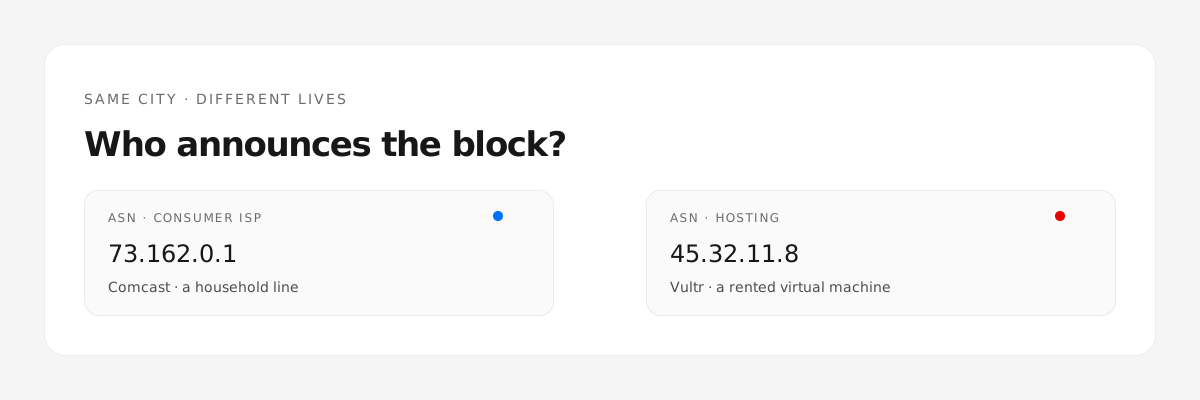
AS numbers, AS paths and upstreams — how to read routing data with public tools, and why the announcing ASN decides the verdict.
Region mismatches are one of the most common reasons a TikTok Shop gets limited. Here is how to check alignment before you apply.
What to verify before you register a new Amazon seller account, and which mismatches trigger the first review.
Warm-up is not a ritual — it is the period in which platforms accumulate evidence about one account. Here is what to do in each window.
Dual-ISP is about routing and peering, not household quality. Here is what the term means and how to tell a real dual-ISP block from a marketing line.
Native IP is not a synonym for residential. Here is what the term actually describes, how to verify it with public data, and which claims are marketing.
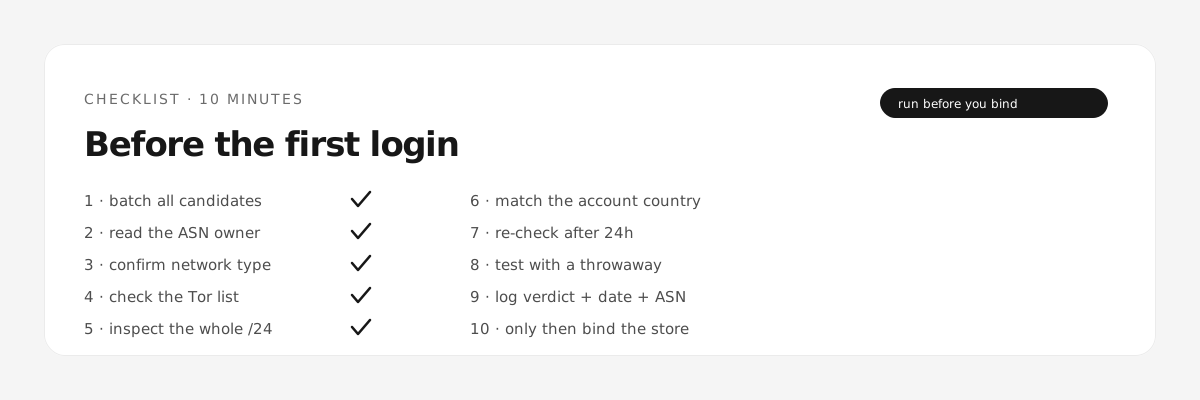
A short, repeatable checklist for vetting the IPs you are about to attach to a new store — before the first login, not after the first ban.
A 72/100 score hides the reasoning. Confidence plus evidence lets you disagree with us — and check the data yourself.
Sellers repackage hosting IPs as residential every day. These five checks catch most of them before they cost you a store.
Residential IP is not "an IP that passes a platform check". It is an address block allocated to a consumer ISP. Here is how to tell the difference.