Reverse DNS (PTR) patterns: what they reveal and what they do not
PTR records are set by the network owner. Here is how to read them, the patterns that suggest a home line, and the cases where they lie.
What a PTR record is
DNS normally maps names to addresses. Reverse DNS is the opposite direction: it maps an address to a hostname, stored as a PTR record under in-addr.arpa (IPv4) or ip6.arpa (IPv6).
dig +short -x 73.162.0.1
# c-73-162-0-1.hsd1.ca.comcast.net.
The network operator sets the record — not the account holder. That is why PTR is useful as a weak signal, and useless as proof.
Patterns worth knowing
| Pattern | Usually means |
|---|---|
| c-73-162-0-1.hsd1.ca.comcast.net | residential cable, dynamic assignment |
| ppp-…dynamic… | consumer DSL / dial-up style assignment |
| static… in an ISP domain | business line with a static IP |
| vultr.com, digitalocean.com | datacenter |
| `` (no PTR) | anything from a lazy operator to a privacy-conscious CDN |
Cloud and hosting providers often set a default PTR containing their own domain, which makes them easy to spot. Consumer ISPs often encode the assignment type in the hostname.
Where it lies
- A datacenter can set a PTR that looks like a household (
home-…). The record is just a string. - A CDN edge may have no PTR at all.
- IPv6 reverse zones are frequently incomplete.
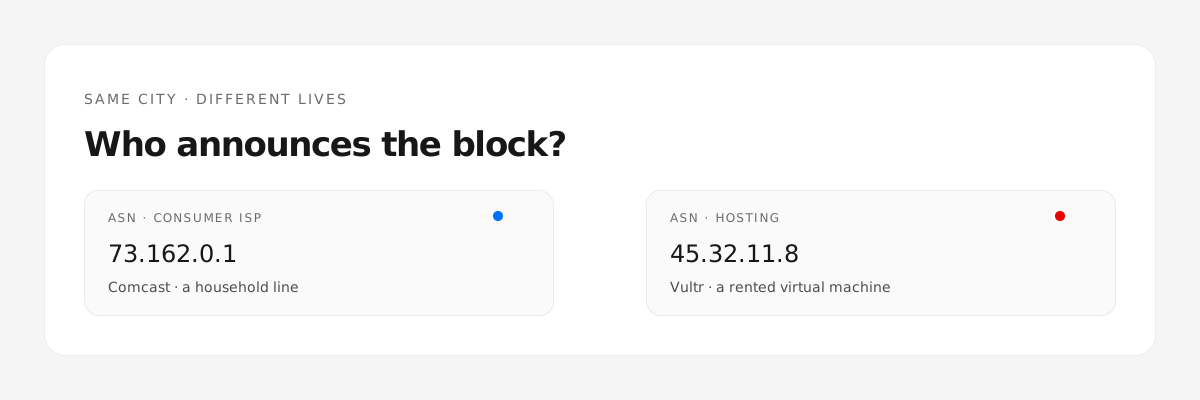
So treat PTR as one of several signals: check it together with the announcing ASN type and the prefix registration. If the ASN says hosting and the PTR says "home", believe the ASN.