What a residential IP actually means (and what sellers get wrong)
Residential IP is not "an IP that passes a platform check". It is an address block allocated to a consumer ISP. Here is how to tell the difference.
The definition people skip
A residential IP is an address inside a block that a consumer ISP — Comcast, Deutsche Telekom, China Telecom, and their peers — hands out to households. The important part is who owns the block, not where the IP geolocates.
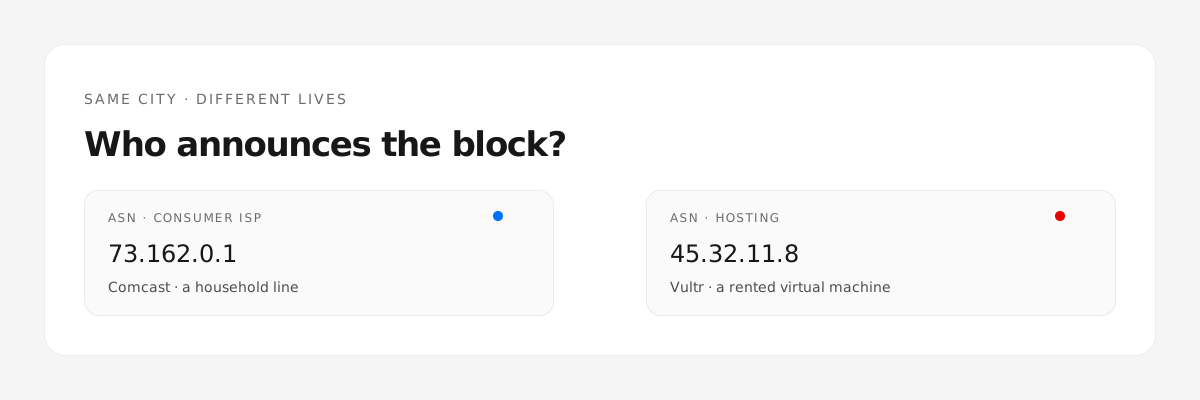
Two addresses can map to the same city on a map and behave completely differently:
73.162.0.1is announced by Comcast. A house, a modem, a family.45.32.11.8is announced by Vultr. A virtual machine someone rents for five dollars.
Both are "US". Only one is residential.
Why the ASN is the giveaway
Every announced range belongs to an autonomous system, and that AS gets a name and a number. When a provider sells you a "residential" IP, the cheapest way to check the claim is to ask who announces the range:
| Looks like | Usually is |
| --- | --- |
| ASN name contains hosting, cloud, vps, datacenter, colo | A datacenter range |
| ASN name is an ISP or carrier brand | Possibly residential |
| ASN is a CDN (Cloudflare, Fastly, Akamai) | An edge network, real exit invisible |
That single field catches most of the bad inventory we see.
What residential does not promise
Even a genuine residential IP can be dirty. It may have been used by someone else before, it may sit behind CGNAT shared by hundreds of subscribers, or it may be a mobile hotspot. "Residential" describes the allocation, not the reputation.
So the honest way to read a verdict is: residential raises the odds, it does not prove cleanliness. That is why our residential verdict caps at around 70% confidence instead of claiming certainty.
A practical rule
If the ASN owner is a hosting company, stop — no amount of "but the seller said residential" changes the announcement. If it is an ISP, treat it as a candidate and verify it with a test account before it touches a real store.