Eight questions to ask before buying a residential proxy pool
Most “residential” pools are resold hosting ranges. These eight questions — and a 20-address test — separate the two.
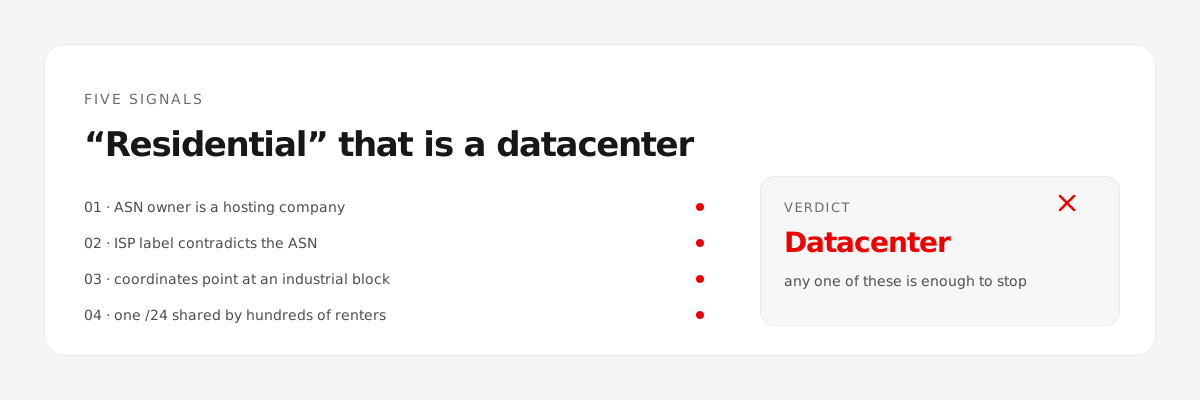
The market problem
Residential proxy pools are sold as a commodity: per gigabyte, per IP, per month. The label "residential" is not verified by anyone, and repackaged hosting ranges are common.
Eight questions
- Which ASNs? Ask for the list. If they refuse, that is your answer.
- Static or rotating? For store registration you want static, not per-request rotation.
- How long does an IP stay with one customer? Shared pools rotate constantly.
- What is the source? Real user devices (SDK-based) and datacenter relays are different products.
- Do you support country targeting? City-level is usually fake.
- What happens when an IP gets flagged? A replacement policy matters more than the price.
- Can I test before paying? Ask for 20 addresses from different ranges.
- What is the refund policy? If the pool is mostly hosting, you want out.
The 20-address test
Take the sample and run it through the checker. Then look at:
- How many are hosting? Above ~30% and the pool is not what it claims.
- How concentrated are the ASNs? One ASN for 20 addresses means one rented block.
- Are the countries consistent? A "US pool" that resolves to five countries is a mix.
Generate a pool report from the same list and send it back to the seller — it is easier to argue with a table than with adjectives.
What to do with the result
If the sample is clean, buy the smallest plan and re-verify after a week. Pools drift: addresses get resold, flagged, or moved. That is also why our watchlist re-checks a saved pool daily.
Check a batch before you buy?
Check a batch →