Can two stores share one IP? What actually gets linked
The IP is one of several linking signals — and usually not the strongest. Here is what links accounts and what does not.
Short answer: no, but the IP is not the main reason
Two stores on one IP are not automatically linked — hundreds of unrelated sellers share a carrier CGNAT address. What links accounts is the combination: same device fingerprint, same payment method, same phone number, same behaviour.
What actually links accounts
- Device / browser fingerprint — canvas, WebGL, fonts, screen. The strongest signal, and it survives an IP change.
- Payment instruments — same card, same bank account, same wallet.
- Phone and email — reused verification channels.
- Behaviour — same listing text, same images, same login times.
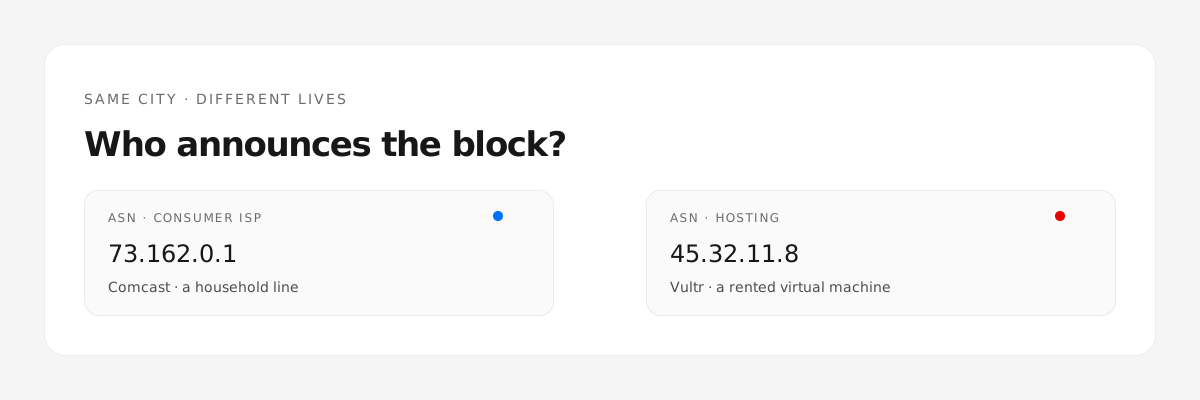
- IP — relevant when the address is unusual (a dedicated hosting IP, a single-address residential proxy), less so on CGNAT.
What to do instead
- Isolate profiles: one browser profile per store, and do not clone it.
- Separate payment rails where the platform allows it.
- Different addresses if you are using dedicated proxies — but do not confuse "different IP" with "different identity".
- Check the network type first: two stores on a datacenter IP is a much stronger signal than two stores on two consumer lines.
The exception
If your "residential" IP is a dedicated proxy address that only your accounts ever use, that address becomes a linking key. That is the case where IP really matters — and it is easy to check: look at the ASN type and whether the address is in a hosting range.
Verify the pool with the checker and use the fingerprint panel to see how much of your identity the browser is leaking.
Check a batch before you buy?
Check a batch →