What "native IP" really means — and the three myths sellers repeat
Native IP is not a synonym for residential. Here is what the term actually describes, how to verify it with public data, and which claims are marketing.
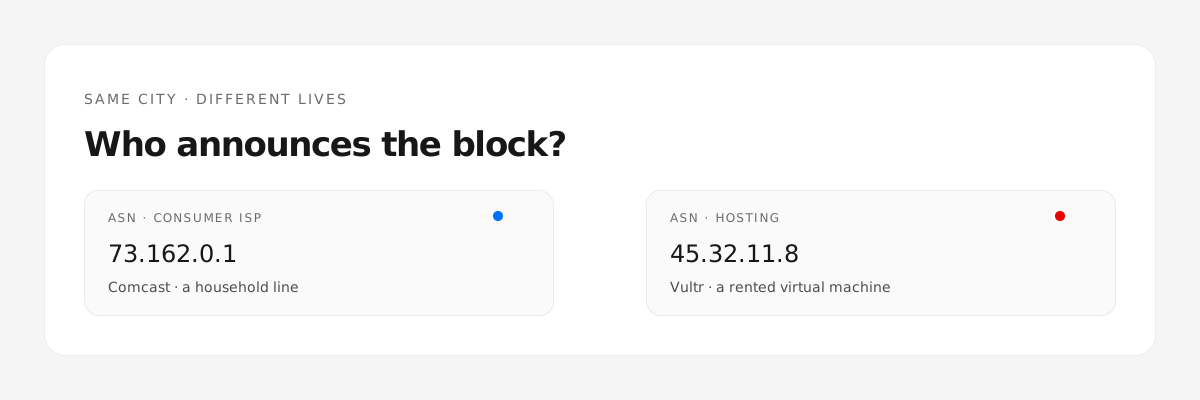
The short definition
A native IP is an address that has stayed with the same ISP, in the same country, and has not been re-assigned from a hosting pool. The point of the word is continuity, not speed or quality: a native line looks like it has always belonged to that household or office.
Two things follow from that. First, native is a property of the address over time, not of the proxy you bought. Second, a "native" label on a sales page tells you nothing until you check the ASN and the prefix history yourself.
Three myths
Myth 1 — native means residential. Residential describes who uses the line; native describes how long the block has been assigned to that operator. A business fibre line can be native and still not be what a marketplace expects from a private seller.
Myth 2 — a rented static IP is native. Static only means the lease does not rotate. If the address sits inside a hosting ASN, it is still a datacenter address with a stable price tag.
Myth 3 — native means undetectable. Platforms look at device fingerprints, payment countries and behaviour as well. IP is one input, not a cloak.
How to verify it
- ASN type. Hosting and CDN ASNs are the giveaway. Our checker shows the type and the operator name (see the network type row).
- Prefix registration. Look the block up in RDAP: who registered it, when, and whether it is a transfer from a cloud provider.
- Reverse DNS. Consumer ISPs often publish a hostname pattern like
ppp-…ordynamic-…; hosting ranges usually resolve to a provider name. - Country consistency. The prefix country should match your account country, your phone country and your payment country.
What to do with the answer
If the ASN is a hosting provider, stop — no amount of "native" branding helps. If it is a consumer ISP, keep the address stable for at least two weeks and check it again before you register. Addresses drift; a clean check today is a snapshot, not a guarantee.
Run a batch through the checker and compare the network type column before you buy another proxy.