Five signs your "residential" proxy is actually a datacenter
Sellers repackage hosting IPs as residential every day. These five checks catch most of them before they cost you a store.
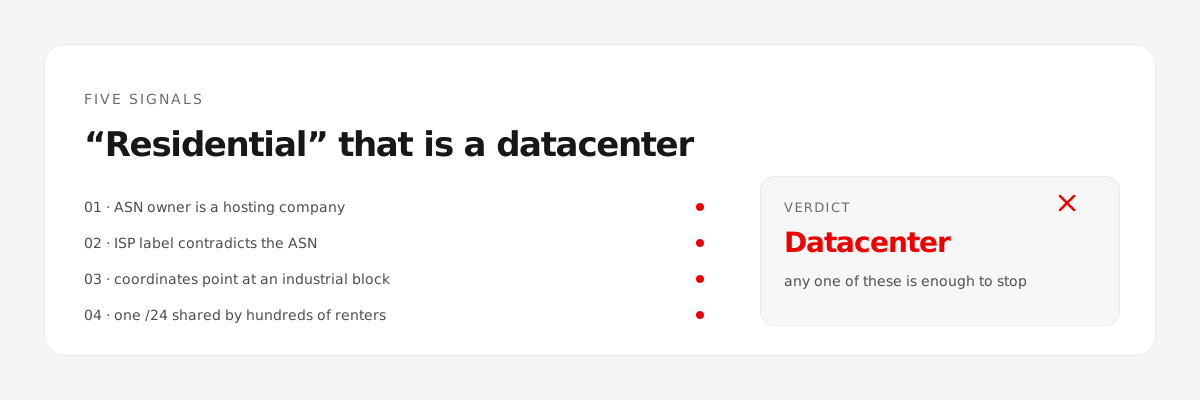
1. The ASN belongs to a hosting company
The most common tell, and the cheapest to check. Vultr, DigitalOcean, OVH, Hetzner, Linode, Contabo, Alibaba Cloud, Tencent Cloud — if the range is announced by one of these, it is a datacenter, full stop. A proxy provider cannot change the announcement.
2. The provided "ISP name" does not match the ASN
Providers sometimes hand-write a friendly location field ("Los Angeles residential") while the ASN says HOSTING. Trust the announcement, not the label.
3. Latitude and longitude point at an industrial block
Residential geolocation is fuzzy — city level at best, often just the ISP's regional hub. If a "home connection" resolves to an address with a data-center campus nearby, ask why.
4. The range is shared by hundreds of customers
Datacenter ranges are usually dense: one /24 with dozens of unrelated servers. If the same /24 shows up across multiple provider resellers, it is a hosting range being resold.
5. The price is too low for real residential
Genuine residential bandwidth costs money to acquire. A "residential" IP sold at datacenter prices is a margin trick, not a bargain.
What to do with a flagged IP
Do not throw it away blindly — datacenter IPs are fine for browsing and some internal tasks. They are just the wrong choice for opening a new store, because hosting ranges are exactly what platforms watch for. Use them where the downside is zero, and keep residential for the store itself.