Dual-ISP addresses: what they are and why "双ISP" claims need checking
Dual-ISP is about routing and peering, not household quality. Here is what the term means and how to tell a real dual-ISP block from a marketing line.
Where the term comes from
"Dual ISP" (often written 双 ISP in Chinese proxy circles) describes a network where a block is announced by one operator but has upstream transit through another. Sellers like the idea because it sounds closer to a real household: the address does not sit alone in a hosting ASN.
That is a routing property. It does not tell you who uses the line, and it does not make a datacenter address residential.
What you can actually verify
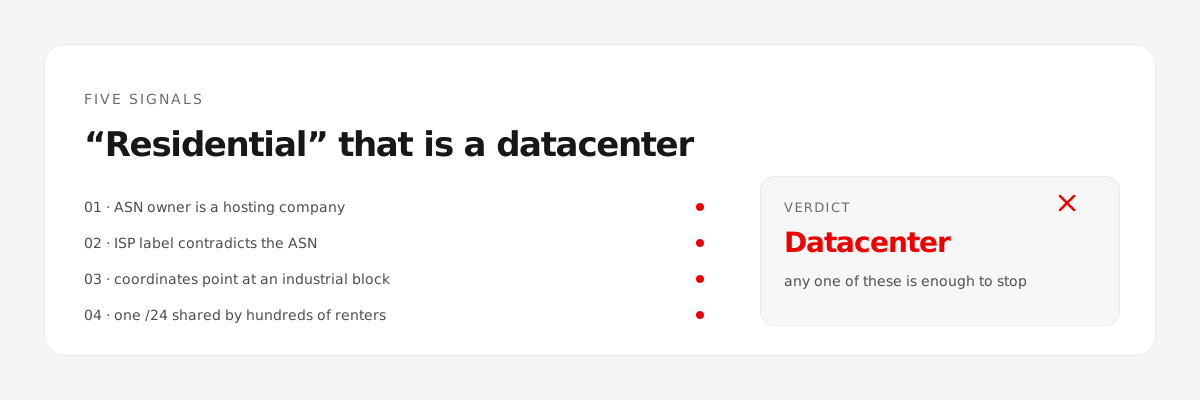
- The announcing ASN. This is what platforms see first. If the announcing ASN is a hosting company, the address is a hosting address no matter how many upstream providers it has.
- The prefix owner in RDAP. Look for the registrant. Residential ISPs and cloud providers have very different registration patterns.
- The reverse DNS. A consumer line usually resolves to an ISP hostname pattern; a hosting line usually resolves to a provider name.
Why the claim is popular
Because it is hard for a buyer to disprove. A seller can show you traceroute output with two providers in the path and call it dual ISP. That proves the route exists — not that the block belongs to a household.
A practical test
Take the IP, look up the ASN type in our checker. Then take ten addresses from the same pool and check them together:
- Same announcing ASN for all ten → it is one block, not a residential cluster.
- Network type repeatedly "hosting" → the label is decorative.
- Mixed ISP/hosting types → ask which block is which before paying.
If the pool is real, the seller will know the answer. If it is relabelled hosting, the answer will be vague.