Why we show confidence instead of a single risk score
A 72/100 score hides the reasoning. Confidence plus evidence lets you disagree with us — and check the data yourself.
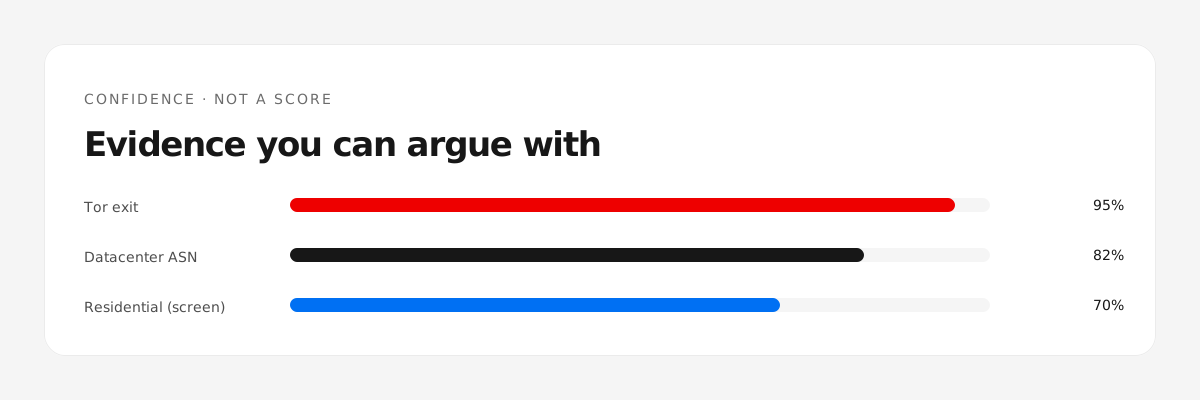
The problem with one number
Most IP tools answer with a score between 0 and 100. It looks authoritative. It also hides everything that matters: which signal fired, how strong it was, and whether the source data even covered this range.
Two IPs can both score 72 for completely different reasons — one is a Tor exit, the other is a shared hosting node with a bad neighbour. A single number makes them look identical.
What we do instead
Each check produces a verdict, a confidence band, and the evidence that produced it:
- Verdict — residential, datacenter, CDN, mobile, VPN, or Tor.
- Confidence — how much the evidence supports that verdict.
- Evidence — the ASN, the network type, the blacklist hit, printed out.
So when we say "datacenter, 82%", you can look at the ASN and decide for yourself.
Confidence is not probability
It is tempting to read 82% as "82% chance this is a datacenter". It is not that. It means: given the data we have, the evidence is strongly consistent with a datacenter verdict — and there is a known gap (for example, we do not license a real residential-proxy feed yet) that keeps us from going higher.
That distinction matters when the decision is expensive. If you need proof, our number should be the start of your investigation, not the end.
The practical takeaway
When comparing tools, do not compare scores. Compare what is shown next to the score. A tool that prints its evidence can be argued with; a tool that prints only a number cannot.